Wednesday, March 09, 2022

Bill Jensen in Stillness / Flowing at Cheim and Reid

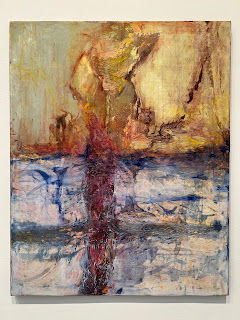
Bill Jensen works from 2017-2021 at Cheim and Reid in Still / Flowing. The press release (excerpted below) claims Jensen has taken every avenue of applying paint, from hand-made tools and hand-mixed pigments, over years of honing technique. It also mentions his study of eastern spiritual traditions. My own definitive memory of Jensen is 2009, at an opening on the Upper East Side, standing atop a stairway I was ascending, looking me in the eye repeating the words, "Red Pine."
What? Who? Taking him at his word I found Red Pine's translations of Hanshan/Cold Mountain, the 9th century monk/poet, which I took with me to China. Drinking Oolong tea while reading the poems in my Beijing studio I thanked Bill silently every day for the gift of the translations, which enfolded nature into every carefully chosen word, compressing time within the starkest phrasing.
Jensen's show functions similarly to such poems: thought pictures passing through material and out again, coalescing and dissolving form.


Color subject, space, afterimage, ghost.

Dense chromatic surfaces bring sonic parallels to Morris Graves' ink drawings of the 1950s.

Sumptious, almost rotted colors, alongside...

Glyphs, ghosts, hovering spirits, whales, with an inky appearance


"These paintings feature a motif that recurs across a number of images, a double yin-yang invented by Jensen. The shape also serves as the basis of a separate series, Wheel Rim Compass, reflecting his lifelong study of Eastern religions, philosophy, and poetry. The form itself is rooted in a canvas he painted in 1977, Redon, which he and his wife, the artist Margrit Lewczuk, re-acquired in 2019.


David Hinton, the acclaimed Chinese scholar/translator who wrote on Jensen's work in his second Cheim and Reid exhibition (2010), published China Root in 2020, a book that traces Ch'an Buddhism beyond recent Japanese interpretation to ancient passage through Taoist China, where its earthy filter grounded Buddhist philosophy in contrariness and immediacy, rising and falling like breath or thoughts.
Jensen's triptych, placed across from the gallery entrance, recalls how Hinton might perceive the question, "What happens if we dismantle all of our human conceptual constructions, all of the explanations and assumptions that structure consciousness and orient us and define us as centers of identity? To do that not in the abstract, but at the level of immediate experience. What would that leave us? What might we discover about ourselves at levels deeper than the contingent histories and thoughts that define us as identity-centers? And what would it mean about the textures of everyday experience?"

The triptych, flanking eternity with symbolic figures that fall through air, simultaneously de-materializing and materializing, reminding us of Michelangelo's Last Judgment, then not, formulates a response.


Tuesday, March 01, 2022

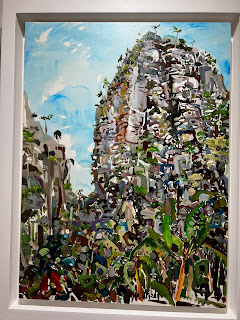
Landscape, Landscape: Lilian Garcia-Roig, Ashley Bickerton, Leon Kossoff

Lilian Garcia-Roig in Hyphenated Nature, January 10 - February 14, 2022, at Gallery 114@HCC Ybor City Campus. Visit the event on the artist's website calendar here: Exhibition Link

"Who we are and where we are from—two seemingly simple inquiries—are complex territories for negotiation that shape the core of our personal identity. Florida-based artist Lilian Garcia-Roig (b. 1966, Cuba) uses landscape painting as a vehicle for examining notions like sense of place, belonging, and identity in both perceptually-based plein-air paintings and conceptually-based studio works."
"In Hyphenated Nature at Gallery114@HCC, Garcia-Roig displays her two approaches to landscape painting side-by-side, reconciling on-site works that capture dense, expressive vegetation with paintings made in her studio using Cuban soil. Seen through the lens of Garcia-Roig’s Cuban-American experience, these distinct bodies of work call to mind the intricate nature of one’s own attachment to time, place, and the lands we inhabit."

Watercolor of remembered space in Cuba. 
Garcia-Roig's signature touch. She pulls her truck to the site, sets up a table, and paints all day in situ.

In contrast to newer works since a trip to her native Cuba followed by a Joan Mitchell Foundation Residency in New Orleans, where she began using Cuban dirt to depict landscapes remembered from the dual perspective of an immigrant.

Ashley Bickerton continues the theme of hyphenation in Seascapes at the End of History at Lehmann Maupin through March 12, 2022. From the press release: "As part of its bold reappraisal of the seascape genre, the exhibition features works from Bickerton’s Ocean Chunk series, which he first conceived of while living in New York City prior to his relocation to the Indonesian island of Bali in 1993."

Survivalist Idyll
River Vector, Big White, 2022, 90.94 x 90.94 inches--Ocean flotsam and beach detritus with stainless steel, etched glass, rubber, brushed aluminum, and plywood
"In a particularly elaborate, large-scale work from this series, Hanging Ocean Chunk (To Be Dragged Up Cliff Faces, Strung Across Ravines, and Suspended From The Forest Canopy) 1 (2022), a square ocean chunk encased in stainless steel rails is suspended from the gallery ceiling. Festooned with a panoply of accessories including carabiners, flags, coils of rope, and climbing equipment, the work suggests and provides for its own transportation through difficult terrain. Beyond its current gallery setting, Bickerton has prepared for possible future installations of this work on cliff faces, over gorges, and high in forest canopies"
"One of the exhibition’s most personal works, Floating Family Footprints (Flow Tide) 1 (2022), documents the trail of footprints left by the artist, his wife, and their child during one of their walks together on the beach. As in the Ocean Chunk series, Bickerton uses resin and fiberglass to create the impression of a surface of shimmering water, beneath which two sets of adult footprints are visible on either side of a smaller, toddler-sized set between them. Like other works in the exhibition, Floating Family Footprints (Flow Tide) 1 features a pair of flotation devices mounted onto the broad slab of preserved beach, indicating its potential use as a raft should the need arise."
Leon Kossoff: A Life in Painting in his first post-humous show at Mitchell-Inness and Nash.

Skewed landscapes in welters and layers of paint that are slathered, ravished.


Several portraits in the show feel less organic than landscapes--this an exception.

Beautiful to see his tilting spaces, layered with history in time.


Wednesday, February 02, 2022

Brenda Goodman: Self Portraits at Sikkema Jenkins, rear gallery

Brenda Goodman's Self Portrait 55, 2006, mixed media on wood, 64 x 62 inches in Self Portraits at Sikkema Jenkins through February 12th.

Self Portrait 4A, 1994, oil on wood diptych, 80 x 72 inches.
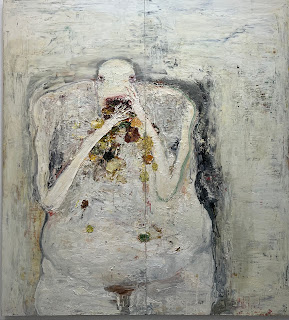
Memories of the early 1990s flood me upon seeing this seminal painting, having seen it exhibited just after completion, though can't remember where, gasping in shock of Goodman's exposure of the hidden struggles usually kept secret. The painting's naked appetite, paint consuming food, body, skin, in a world that feeds itself, a studio full. The woman's response to Giacometti's existentialist disappearing subjects looms among us, Kristeva's description of milk casting the Power of Horror anew for those too afraid to face it: horror not in exposure but the necessity to hide. Social media awareness changed this but even braver, the artist now.

Self Portrait 20, 2005. The artist reviews subjects and objects. 48 x 64 inches.

Self Portrait 17, 2005, oil on canvas, 68 x 84 inches. A strange Nordic or North Atlantic composition with dark huddled bodies atop a beached ice flow form and a huddled audience up front. A winter painting for a winter season.

Details of Self Portrait 4, 1994, 60 x 60, a supplicant Gilles mad the same year as Marlene Dumas' Painter. Unlike the girl with stained red hands, our protagonist is masked and withdrawn, yet corporeal in all ways Dumas' heroine isn't. 


Brenda Goodman, Self Portrait 4, 1994, 60 x 60 inches
Marlene Dumas, Painter, 1994 (image clip online)

Self Portrait 7, 2004, oil on wood, 60 x 65 inches. Imprisoned within a lustrous, elegant surface that remerges in new works including the geometric divisions, palpable as a quavering line. 

A work on paper, behind glass, showing the drawing acumen beneath the built surface.

Detail,Self Portrait 7: packed surface.

Grounding the portraits of the 1990s: Self Portrait I, 1974, oil, mixed media on canvas, 60 x 48 inches, in which drawing plays a primary role. We see the elegance of Goodman's palette, her elegant, Surreal, even Imagist imagination before appetite subsumes her vision and paint stops behaving.

Paint becomes the psychological descriptor of consciousness and habit, paving the way for image-makers like Allison Schulnik. 
In Feminism and the Legacy of Surrealism at Thomas Erben: Untitled, 1973, oil on canvas, 72 x 96.  

Brenda Goodman, Not Long Now, 2021, oil and mixed media on flatboard, 12 x 16 inches. The 1990s appear in scarred surfaces that alternate with smooth areas. Pain incorporates as enfolded forms, returned to color with a measure once reserved for drawing.