
Wednesday, February 29, 2012
Travelin'


Wednesday, February 15, 2012
Conversations with I-Hsiung Ju
Professor Ju's website
Welcome to I-Hsiung Hu's instruction on the Four Gentlemen (bamboo, orchid, chrysanthemum and plum blossom). These idioms introduce the texture strokes that define Chinese landscape, and in so doing, provide elements of calligraphy and stroke order. I'm using I-Hsiung Ju's quartet of instruction manuals, purchased in a 2007 visit to his studio. The Four Gentlemen are dorky, but they are also fun and I am glad to have the thorough, step by step instructions and cultural background for the idioms that I-Hsiung Hu's books provide.
To copy the idioms and memorize the stroke orders is to immerse into a silent conversation with Professor Ju. He issues admonishing "don'ts!"to accompany images that transgress proper application. He wants to redirect focus from crossed branches, awkward downward facing flowers or rigid vertical compositions to alteration of placement, tone and mark. This requires much pre-planning: leaving space on branches to allow one to cross in front, be sure that heavy elements rise to weightlessness with the size and emphasis of the brush, or balance the ink load between dark and light, dilute and dry. The principle of alternity expands within landscape composition, deploying open/closed or host/guest relationships within a balance of empty and full. Way more conservative than the free-wheeling literati whose paintings continue to amaze and delight, Professor Ju nonetheless bestows readers, at least this one, the ability to 'read' Chinese paintings with knowledge. Our conversation is studded with exclamations (I wiped out! Stop saying don't!) and dawning recognition of previously hidden points, such as the distinction between composing and performing, which become philosophically profound.
Luo Ping, whose work was exhibited in “Eccentric Visions: The Worlds of Luo Ping (1733–1799)” at the Met in 2009, took plum to unprecedented levels of expression. Profusions of blossoms drip from flowing branches, rather than the minimal flower arrangements on jagged trunks Professor Ju instructs should be "ugly, pale and awkward." For Luo Ping's family, plum painting was their livelihood. Below, one observes an active shift from the performance role of execution to the composer role of innovator. Within the embodied process of painting, the two fuse together in seamless delight.

 |
| "boneless" tree with outline flowers |
 | |
| plum blossom whiskers |
 | |
| plum tree practice, outline method |
 | |
| Double flower, outline method |
Welcome to I-Hsiung Hu's instruction on the Four Gentlemen (bamboo, orchid, chrysanthemum and plum blossom). These idioms introduce the texture strokes that define Chinese landscape, and in so doing, provide elements of calligraphy and stroke order. I'm using I-Hsiung Ju's quartet of instruction manuals, purchased in a 2007 visit to his studio. The Four Gentlemen are dorky, but they are also fun and I am glad to have the thorough, step by step instructions and cultural background for the idioms that I-Hsiung Hu's books provide.
To copy the idioms and memorize the stroke orders is to immerse into a silent conversation with Professor Ju. He issues admonishing "don'ts!"to accompany images that transgress proper application. He wants to redirect focus from crossed branches, awkward downward facing flowers or rigid vertical compositions to alteration of placement, tone and mark. This requires much pre-planning: leaving space on branches to allow one to cross in front, be sure that heavy elements rise to weightlessness with the size and emphasis of the brush, or balance the ink load between dark and light, dilute and dry. The principle of alternity expands within landscape composition, deploying open/closed or host/guest relationships within a balance of empty and full. Way more conservative than the free-wheeling literati whose paintings continue to amaze and delight, Professor Ju nonetheless bestows readers, at least this one, the ability to 'read' Chinese paintings with knowledge. Our conversation is studded with exclamations (I wiped out! Stop saying don't!) and dawning recognition of previously hidden points, such as the distinction between composing and performing, which become philosophically profound.
Luo Ping, whose work was exhibited in “Eccentric Visions: The Worlds of Luo Ping (1733–1799)” at the Met in 2009, took plum to unprecedented levels of expression. Profusions of blossoms drip from flowing branches, rather than the minimal flower arrangements on jagged trunks Professor Ju instructs should be "ugly, pale and awkward." For Luo Ping's family, plum painting was their livelihood. Below, one observes an active shift from the performance role of execution to the composer role of innovator. Within the embodied process of painting, the two fuse together in seamless delight.

Wednesday, February 01, 2012
Tuesday, January 17, 2012
Dana Schutz Interview
 |
| Keith Mayerson skillfully interviews the incomparable Dana Schutz for the exhibition, "8 Americans," which he organized for Maruani & Noirehomme Gallery, September 10 - October 29, 2011 in Brussels, Belgium. Click on the link above to access the interview as well as others with Schutz and Mayerson's fellow exhibitors Hilary Berseth, Joe Bradley, Ann Craven, Francesca DiMattio, Wade Guyton and Jacob Kassay. |
Sunday, January 01, 2012
Hawaii: Masterpieces of Landscape Painting from the Forbidden City
 |
| Honolulu Academy of the Arts exhibition - welcome! |
 |
| More from the exhibition--this looks like Wang Meng |
 |
| The final exhibition photo before museum intervention--cannot identify the gorgeous bamboo, rock and calligraphic composition to left--Wu Zhen?--see another image on museum website, linked above. How beautiful the ornamental doorway! |
 |
| View from Moana Surfrider - like Chinese landscape... |
 |
| Westin's Moana Surfrider hotel, founded 1901 |
 |
| Hawaii Botanic Garden |
 |
| Hawaii Botanic Garden shoreline |
 |
| Looking up at million year old Mauna Kea (13, 796 ft.) from the Saddle Road at about 6000 ft. in Hilo |
 |
| Public park in Hilo, island of Hawaii (all photos courtesy PM) |
 |
| Lunch |
Friday, December 23, 2011
Los Angeles
 |
| A gorgeous Caspar David Friedrich at the Getty, West Los Angeles |
 |
| One of my favorites from the Getty villa in Malibu in years past: Winterhalter |

 |
| Gerome! |
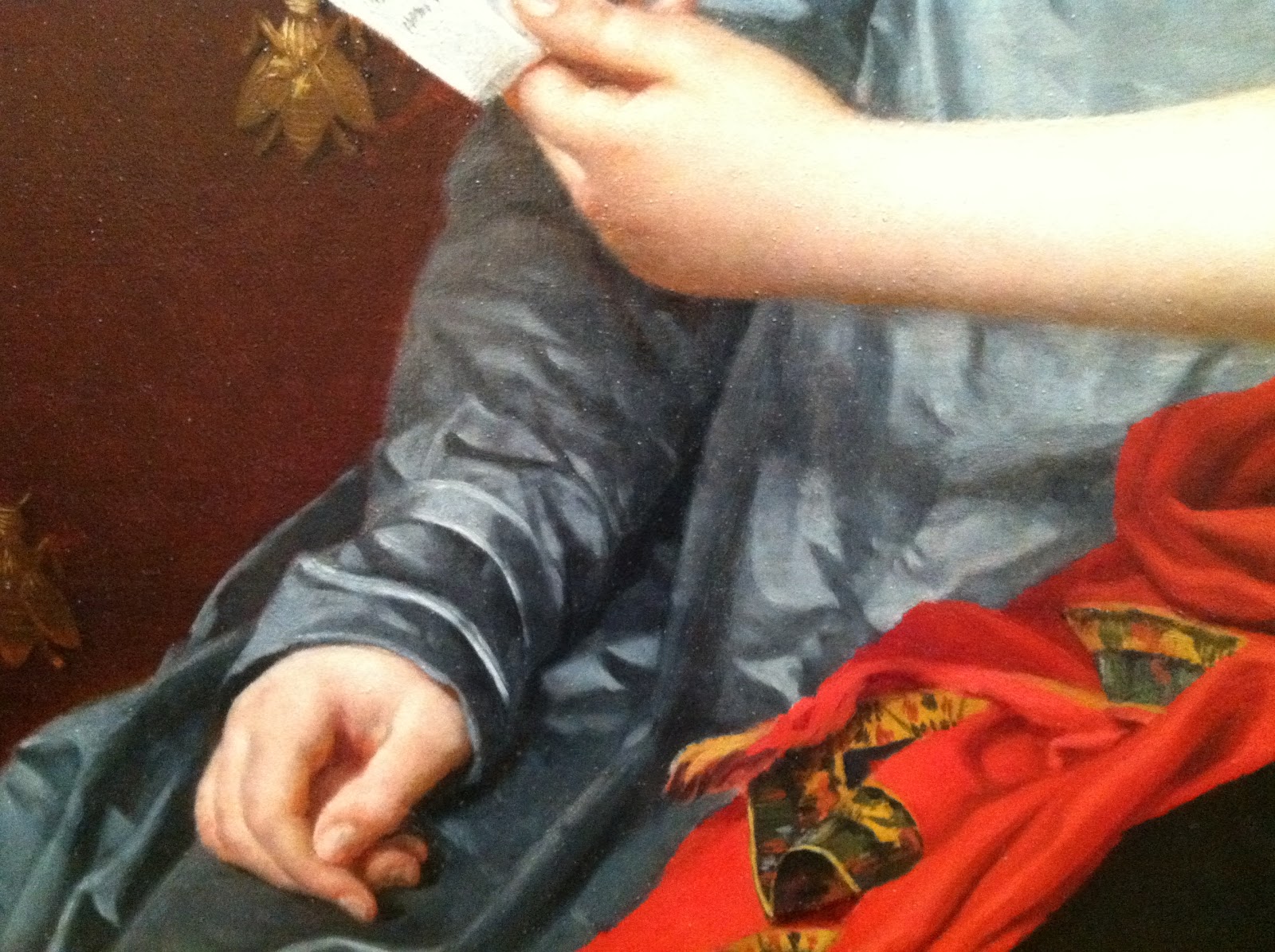 |
| Some sumptuous brushwork - lost by the iPhone - David |
 |
| Jacques Louis David, The Bonaparte sisters 1821 |
 |
| Fleshy and brassy diagonals in David |
 | |||
| Jacques Louis David, Farewell of Telemachus and Eucharis, oil on canvas, 34.5 x 40.5 inches |
 |
| Sunset looking south toward Hollywood |
 | ||
| Exene Cervenka and John Doe from X in the film at Geffen Contemporary |
Friday, December 16, 2011
Transformation

"'Antiquity' is but a tool of knowledge; 'transformation' involves recognizing it as but a tool while refraining from using it in this way. For I have never seen anyone achieve transformation by using antiquity as a tool. Often I lament those who are mired in antiquity, unable to transform themselves because their knowledge has trapped them. It traps them in stylistic imitation so that their vision is narrowed. For this reason, the superior man just uses antiquities to expand the potentials of the present."
..."I am myself because 'I' naturally exists. The whiskers and eyebrows of the ancients cannot grow on my face, nor can my body contain their entrails. I express my own entrails and display my own whiskers and eyebrows. Even when there may be some point of contact with some msater, it is he who comes close to me, not I who am trying to become like him. Nature has endowed me thus. As for antiquity, how could I have learned from it without transforming it?"
Shih-T'ao, Enlightening Remarks on Painting, 1700. Translated by Richard E. Strassberg, Pacific Asia Museum Monographs, No. 1, 1989
Wednesday, December 14, 2011
Frank Bowling, Sarah Walker, Fabian Marccaccio and Rebecca Morales at Seven
 |
| Frank Bowling - a new discovery. Both paintings approx. 95 x 69 inches |
 |
| Ah Susan Whoosh, 1981 @ Hales Gallery - http://www.halesgallery.com |
 |
| Bowling - detail |
 | |
| Another beauty by Bowling |
 | |
| Sarah Walker at Pierogi at Seven Art Fair-http://www.pierogi2000.com/artists/sarah-walker/ |
 | |
| Sarah Walker, Having Built Here BEfore, 2010, acrylic on panel, 20 x 22 inches These paintings get weirder and weirder, in the best way--complex rhythms and structures but also look fun to make. |
 |
| Fabian Marcaccio - http://www.bravinlee.com/ |
 |
| Marcaccio, Detail - he's baaaaack! |
 |
| Rebecca Morales @BravinLee Programs - http://www.bravinlee.com/ - new discovery |
Saturday, December 10, 2011
Light and Space East Coast style at imPulse and ABMB
 |
| Brookhart Jonquil at Dorsch Gallery, ImPulse. For more on Jonquil, click link above. |
 |
| Florescent orange paint at the end of each wood strip and metal attachments contributed a snowflake or jewel-like feeling. |
 |
| I think by Aaron Curry at Michael Werner, but now cannot be sure. Loved these. |
 |
| Aaron Curry again. |
 | ||
| Robert Miller's booth, ABMB: Paul Jenkins Phenomena high alter wall, 1977, Acrylic on canvas, 75 x 150 inches, 190.5 x 381 cm © 2011, ProLitteris, Zurich |
 |
| An unusual monochrome by Jenkins. |
 |
| Steven Parrino--at Skarsdedt? |
Friday, December 09, 2011
Rico Gatson at Seven, Miami
 |
| Rico Gatson - "Angela" |
 |
| More Gatson-washed out image that conveys materiality of surface. |
 |
| Black and white fire. |
 |
| So glad to see these at Seven having missed Gatson's Exit Art retrospective. Love the reductive elegance of his work. Its content is firmly embedded within material: a visual experience that conjures historical events without literalness. Click link above to read more on the artist and see more of his work. |
Tuesday, December 06, 2011
Figuration at Seven and Pulse
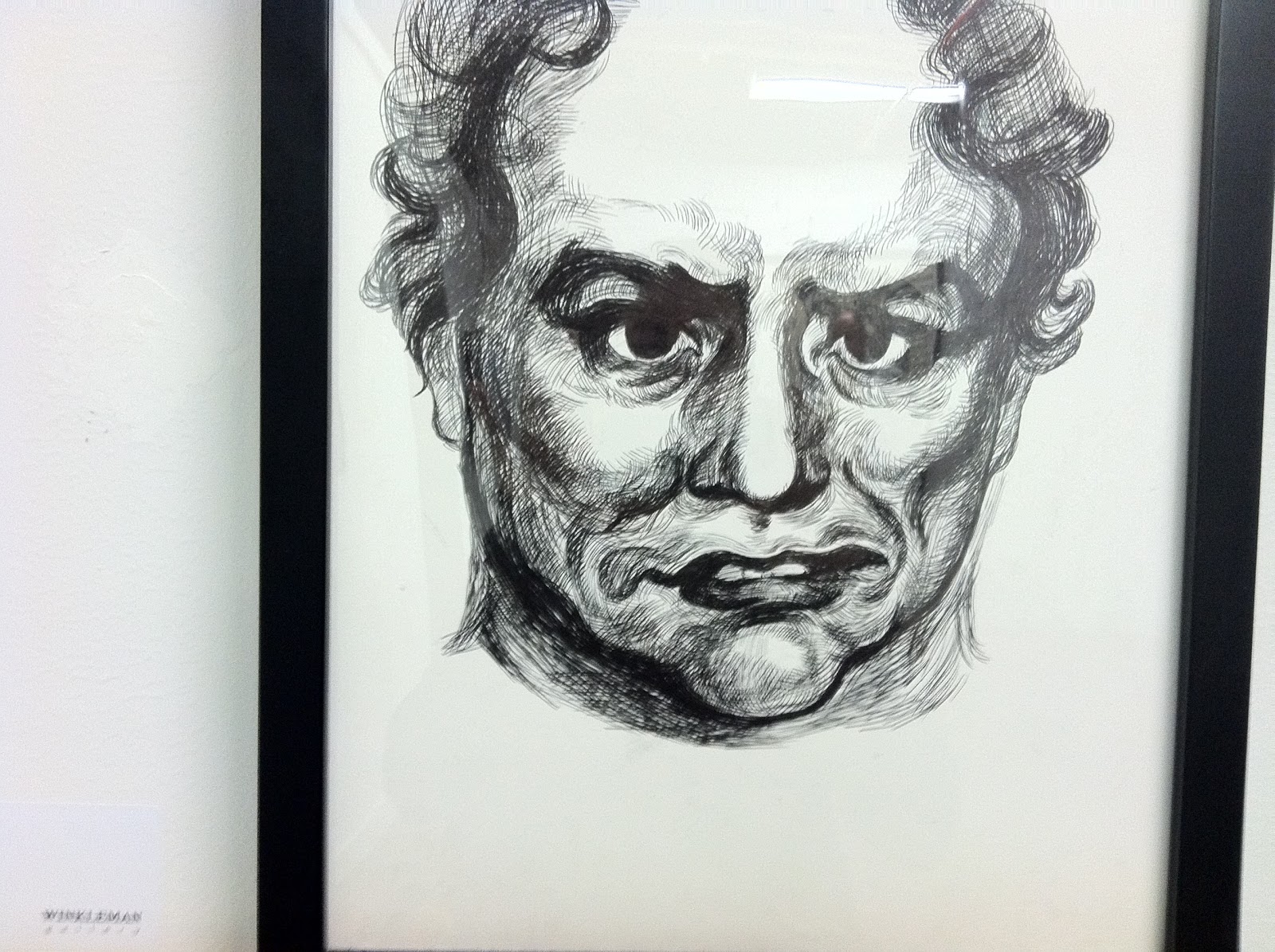 |
| Sarah Peters at Winkleman, Seven Art Fair To visit her gallery page at Winkleman, clink link above |
 |
| Sarah Peters, quartet of portraits. To visit her website, go to: http://sarahpetersart.com/ |
 | ||
| Robin Williams, Golden Nugget, oil on linen, 62 x 80 inches, PPOW at Seven Art Fair |
 | |
| Detail, Williams |
 | |||
| Julie Heffernan, PPOW at Seven Art Fair |
 | |||
| Heffernan at Mark Moore, Pulse |
 | |
| Heffernan, detail |
 | |||
| Allison Schulnik at Mark Moore, Pulse |
 | ||
| Katie Miller at Conner Contemporary, Pulse |
 | |||
| Erik Thor Sandberg at Conner Contemporary, Pulse |
Subscribe to:
Posts (Atom)


