Always a lovely sight, MoMA's Rockefeller Garden on a fine fall day. This will always remain ground center of New York for me, the defining space and feeling of what the city is.
There was a beautiful print show with, in this pair, a theme of black and white--a print by Kiki Smith, so textural and rich, with
the variegated textures of Nicole Eisenman's multi-process print.
Huguette Clanand's Visages caught my eye (1979), passing through the permanent collection.
My favorite Ed Ruscha painting of all time, Los Angeles County Museum of Art on Fire, from 1965-68. I took art classes with Renate Zerner at LACMA. Nine or ten, terrified, I crafted birds and dogs from ceramic with a bunch of other kids. Zerner spoke with my mother, and invited me to study privately at her Westwood apartment. In her sun-soaked living room she played Judy Collins' Send in the Clowns, while I poured food coloring on paper and drew on vast sheets of newsprint. While for Ruscha, "fire is really an after-statement--like a coda, as in a coda to music," the museum is my key to liberation.
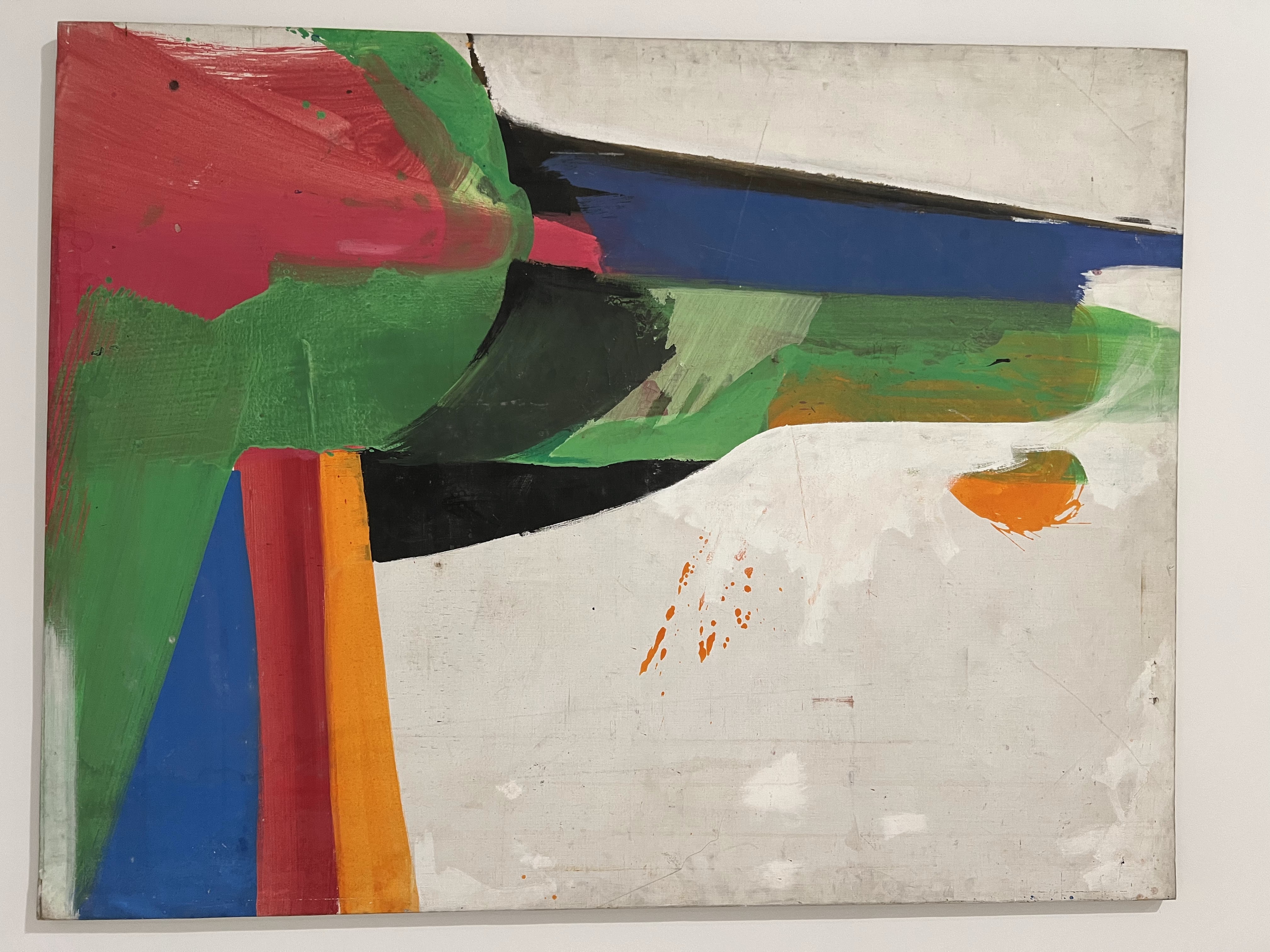
The coda in Ruscha MoMA exhibition are Azteca/Azteca in Decline, "inspired by a roadside mural" when the artist drove to "Teotihuacan, the ancient Mesoamerican archeaological site near Mexico City" I too visited in 2020 just before the pandemic broke. These paintings represent "how things go from robust to desolate," but there is such great beauty in the decay.
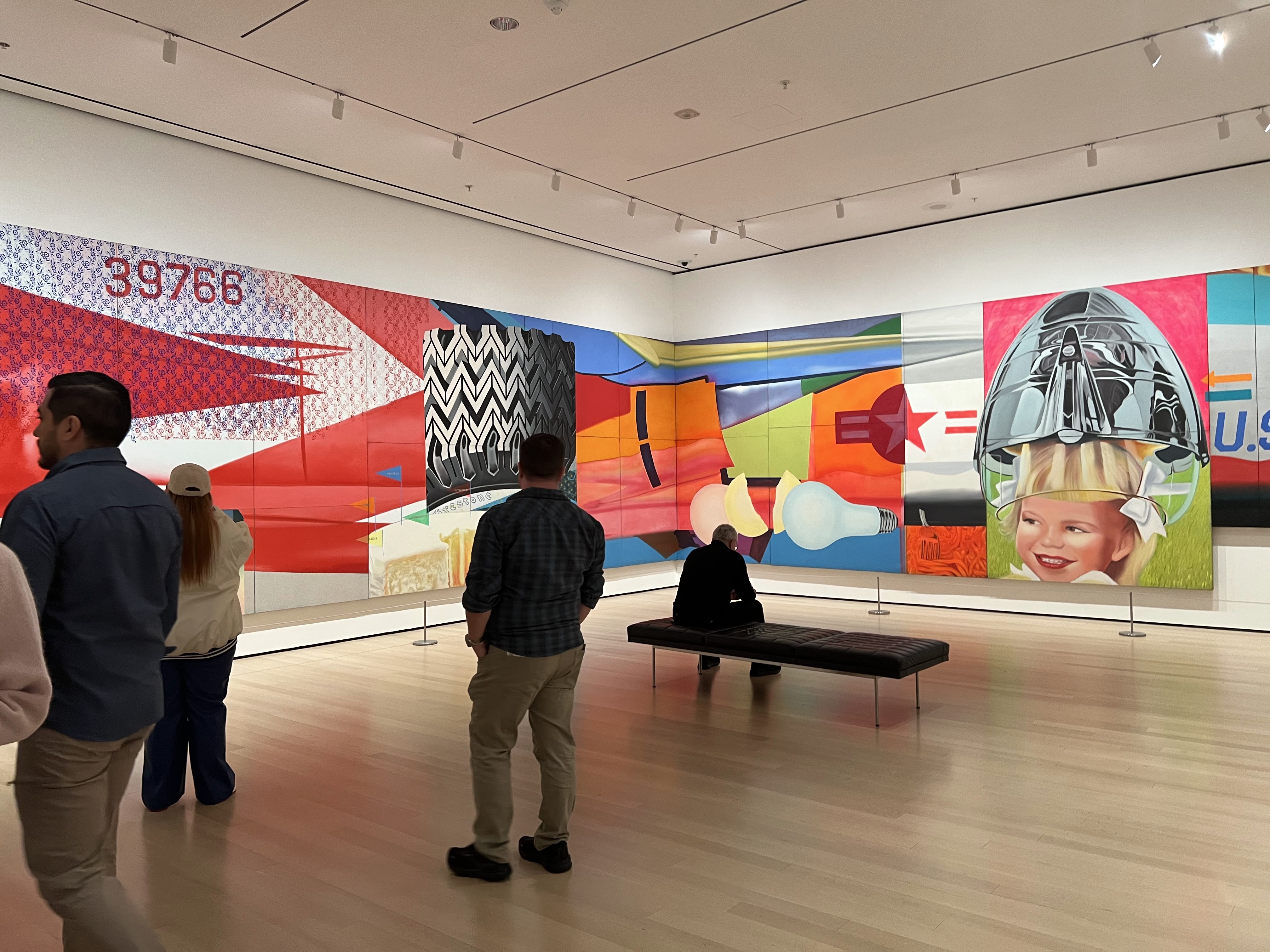
Always necessary to honor James Rosenquist's seminal room-wrapping mural F-11 (1964-5), certainly the backdrop to consumerist mid-century America, masking social critique in cheery color.
On the Lower East Side, very small, lovingly painted works by Anna Calleja: Black Mirror, 2023, 9-7/8 x 7-7/8 inches (above), and The Sound of You Dreaming, 2023, same dimensions, below, at James Fuentes.
Also at Fuentes, Onur Gokmen's Mochu, 2022, cardboard, modeling clay, paper mache, passport photo, and plaster--as a corollary to Frederick Kiesler's Endless House of the 1940s, a conceptual work in which the house has no structural seams and favors a curvilinear structure.
A soft, tonal painting by Igor Moritz, 2022-2023, 2023, 14-4/5 x 9-4/5 inches.
At Patricia Fabricant and Jaynie Crimmins' curatorial triumph at Equity Gallery, Process & Delight: The New P&D, I was happy to learn of Carolyn Wayne's meticulous beaded sculpture. Through the aesthetics of her well-heeled family, she explores underlying issues of abuse and exploitation.
Teamed with Oriane Stender's weaving, which shared iridescent highlights that appeared flickering, even while embedded in the material.
Nearby,Marcy Rosenblat's mysterious lacy form, surprisingly solid in the most pleasing way.
Patricia Fabricant's love for wood patterning has led to adventuresome optical territory. It's a pleasure to gaze at these paintings, to be seduced, then ejected between planes across the surface in a process of push me pull you.
Exquisite pencil drawings by Chris Arabadjis segue from front to back room. These are quite beautiful and well-made.
New small works by Amy Chen, which have a surprisingly rough quality for this mistress of imbedded elegance. The new element of shiny markers adds graphic, almost violent layered touch that embodies the frenetic pace of the city and brings an exploratory element to her work. Exciting!
Jaynie Crimmins, co-curator, "offers a critique on materialism...through her use of post-consumer remnants," comments essayist / artist Etty Yaniv, and from the dross creates devotional objects with the intimate feel of icons, or milagros.
In counterpoint to Patricia Fabricant, David Ambrose initially keeps the viewer at bay with writhing marks, which with prolonged viewing coalesce into patterns and shapes.
Charles Clary showcases his woven interventions, in prefabricated frames, in a stunning back room installation.
On the patio, ecological interventions by Theda Sandiford.
Sargents Daughter presents Yevgeniya Baras in the solo show Stargazer.
The work was made over several year on a Fulbright in Tel Aviv.
Wood pieces are sewn on and painted around. Oil vies with collage elements, like cloth.
Star of show, both figure and luminous landscape, though no claim by the artist as subject.
It is just gorgeous paint abutting raised separations.
Perhaps I'm overly sympathetic to flower and lattice formations, but couldn't help seeing them.
In conversation with a friend in the gallery, references to Southern California, and hippies arose, relating this work to the funky fabric works of Alan Shields or Judith Scott. The more I looked at these, the less they appear so. Yes, they're properly casual, scruffy or casual, pick your word-- Tel Aviv is latitudinally southern--but the intensity of marking feels urgent rather than chill.
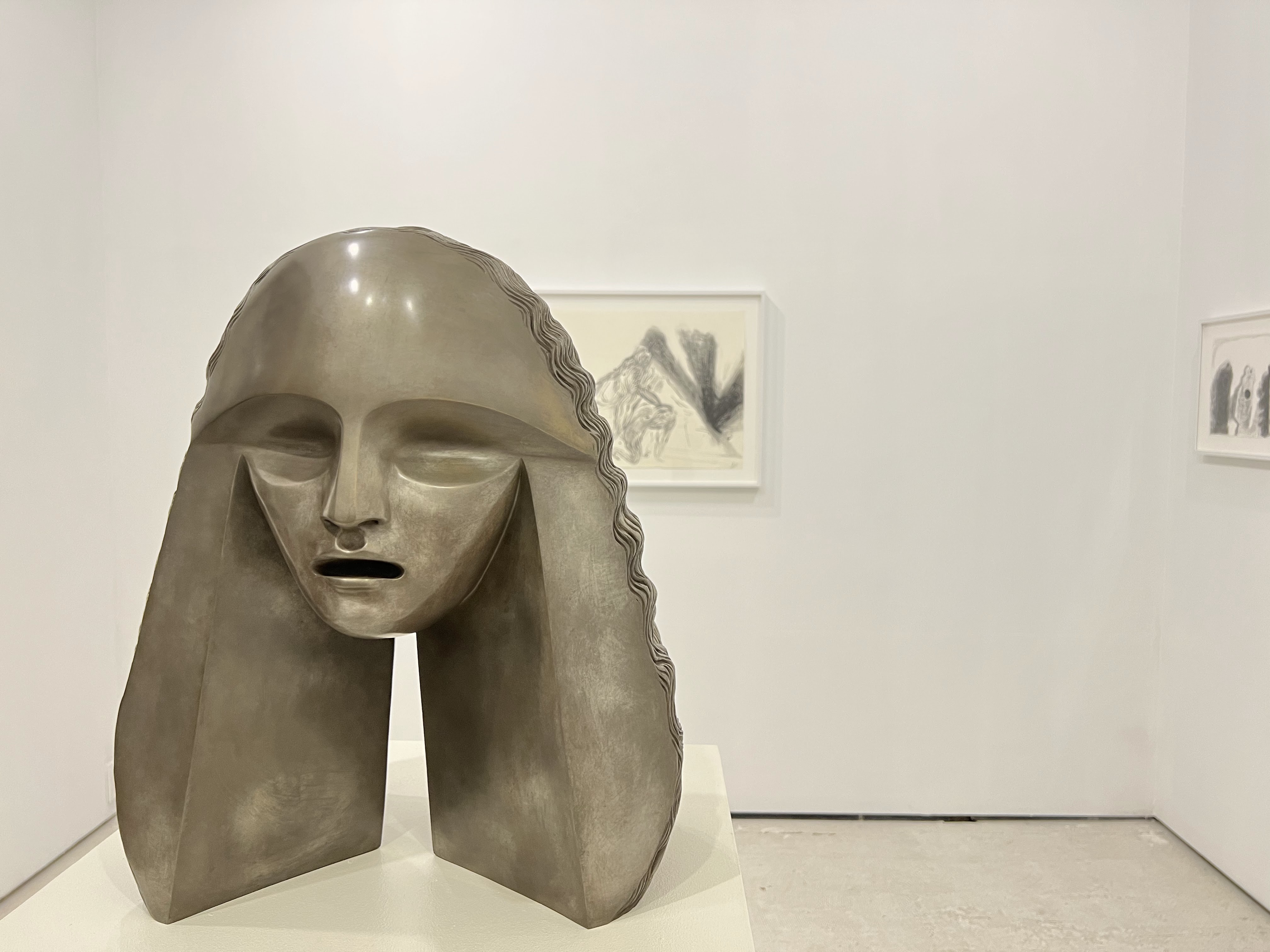
At Nathalie Karg, Sarah Peters creates a world of strange bronze beings, informed by the invisible faith-based convictions and dynamics in religion.
The front of this bound, split heads boasts a large "SP" in cursive on the face--literally a delicate slap.
Architectural hairlines and incised patterns suggest underlying geometric orders in fleshy human form.
We begin to meet characters, an avuncular authority with cloven beard and hollowed head,
The watchful siren, doubling as an observation tower,
Submissive behind, sounding the warning~
Cast bronze surfaces hold the implications tight
Avatar, siren, prey, the bronze transforms her into inviobality
Ink drawings propose various narratives that inform the inner lives of the bronze forms
They gaze back and forth at each other
A kind of psychological backstory
A vibe, a spirit world, that intersects with but ultimately does not shape the bronze figures.