Tuesday, June 10, 2014

Myth/History: exhibition at mega collector Budi Tek's new Yuz Museum, Shanghai outpost

Collector Budi Tek's Yuz Foundation opens a new, 9,000 s.f. venue in Shanghai, in addition to the one in Jakarta, Indonesia. The collection is curated by Wu Hung and Martina Koeppel-Yang, among others.
The first images here establish scale. Above, a John Chamberlain-like block of detritus--instead of metal cars, burnt, heaped animal corpses.

Themes of loss and death continue in Adel Abdessemed's three aircraft, pretzeled together and  reminiscent of, in form if not mood, Nancy Rubin's exuberant works.

The first thing you see walking through the door: a large Buddha's hand. This is the back. The front has a symbol emblazoned upon it.

Another view of the planes, and Yang Fudong's cinematic photo series, above


Sun Yuan and Peng Yu's Angel, 2008.  Immanence and transcendence, here reversed as strange familiarity induces real space.

Intricate room of meshed screen housing a skeletal creature with waving antennae and breathing spine, breeding custos cavos, a kind of replicating cell according to the artist's mythology.


Xu Bing's tobacco series--several small and large works made in Durham, US about the industry and its links to higher education, among other social influences.

Moving deeper into the space of the exhibition, a Fred Sandback installation.

A densely surfaced ink work by Yang Jiechung (1991-2).

Stepping back

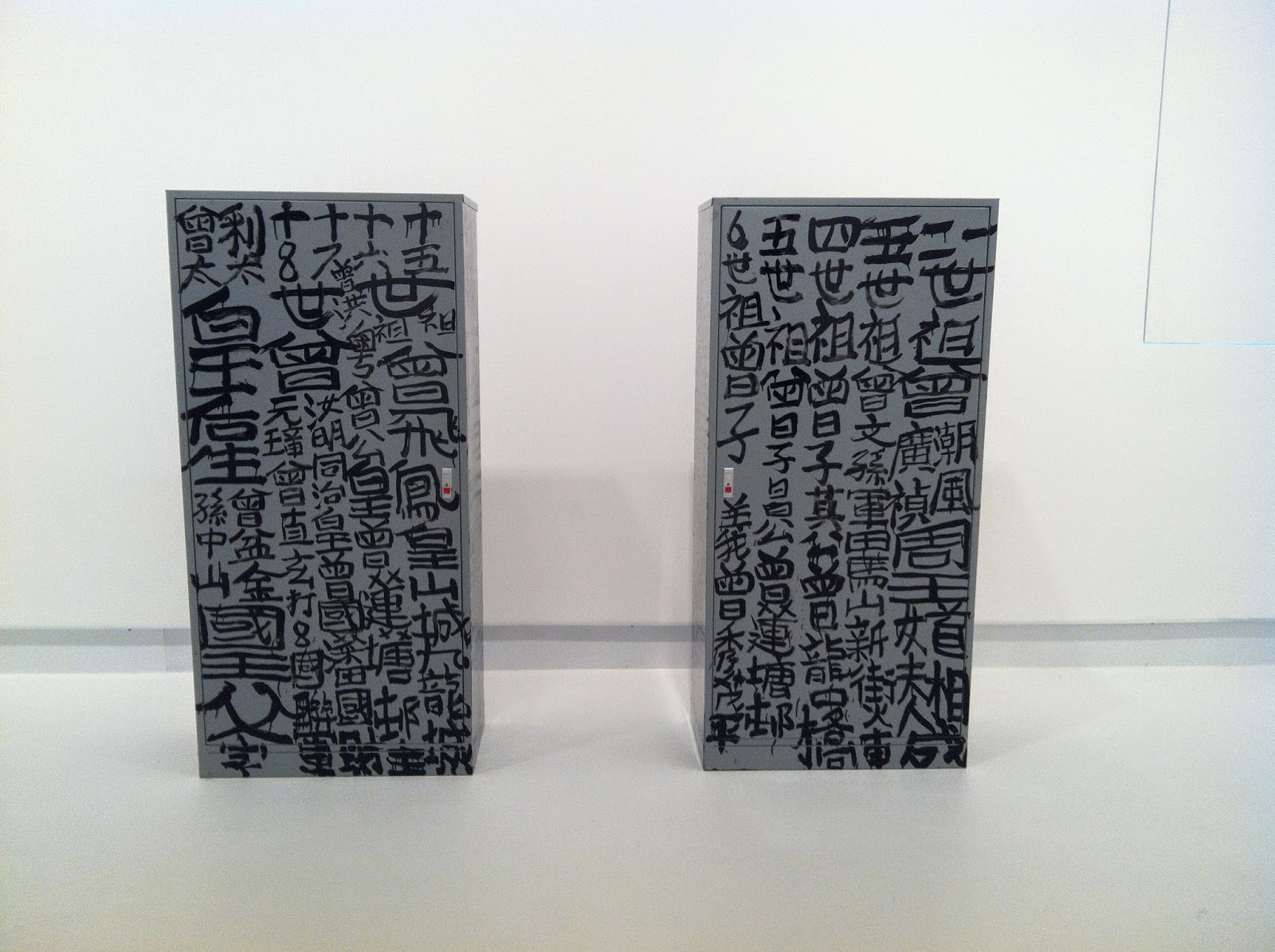
Tsang Tsou Choi, d. 2007, Hong Kong--a so-called lunatic who painted on every available surface.

His work can also bee seen at the Rockbund's current exhibition covered earlier (partially) on this blog.

Mona Hatoum's Impenetrable (2009), black finished steel and fishing wire.

Yu Ji, Flesh in Stone. 

Yu Ji, Public Space #5, in which he posits via Benjamin that memory, when isolated, creates new contexts and possibilities.

Li Shan, The Earth Without Form, 1982. For me the most enigmatic and compelling painting on view. Why? I felt the accrual of brush marks massing like ink, in the language of oil...the thin, yellow lines both containing and expanding on them, a curious addition...having been working on ink paper it felt like a very direct translation of mediums. I want to know more about this artist.

These works by Zhang Peili (Red, Yellow, and Blue, 1993)  recalled the May 2014 exhibition at Mulherin-Pollard Gallery on the LES--as well as1990s figuration in NY with very different purposes.

Wu Genda's large calligraphic works. This takes serious chops to pull off. I believe he makes his own ink from hair, but must research this to make sure, so don't quote me yet.

Zeng Fanzhi's compelling translation from ink. At first, I thought, "Paula Rego," but going deeper one sees the reckoning with gesture, and history.  

Zeng Fanzhi detail from Man and Meat, 1993.

Yue Minju's Enfanta


Shanghai 2008: neon lights by LI Shurui. 

Acrylic. Airbrushed?

A suite of paintings by Liu Wei, Yan Pai-Ming, Mao Yan and Qi Sheihong.

Yan Pei-Ming's portrait of Liu Xiaodong, 2012

By LIU Wei, I believe.

An early Liu Xiaodong work (1991). I enjoyed seeing transitional works by several artists in this collection.

Liu Xiaodong, Detail

LI Songsong's Decameron, 2004


WANG Xingwei, Lower Half, 2000--so reminiscent of the Fraser/Jagger hand tinted photo in the 1960s and with the same idea, going after corrupt officials this time--or so it seems.

Yan Pei-Ming, two of three skulls and a portrait

Exiting, an installation by Madeln Company (collective), 2009. Calm. Reminiscent of the rubble lots everywhere in China's cities, causing architectural phenomena such as 'nail houses.'

Outdoor sculpture garden to the side of Yuz

Exterior--entrance

The wide avenue, Fenggu Lu, heading back to the newly built 11 line (take line to Yunjin, exit right on Yunjin Lu, right again on Fenggu). Like Miami, Shanghai has a number of personal museums. It is fascinating to know a collector's vision. The Yuz Museum opened just several weeks ago, so it will be interesting to see how it unfolds over time.

Sunday, June 01, 2014

Ross Lewis at Front Line Contemporary


I met Ross Lewis, now exhibiting drawings with Chinese colleague Qiu Deshu at Front Line Contemporary, Shanghai, over dinner at M on the Bund with mutual friend Caitlin Reilly. What a delight to meet someone so fluent in, and passionate about, Chinese culture. Ross has studied Chinese language and painting since 1973, and is fluent in both. Here, he delivers a bilingual lecture on his work at the gallery. Link to Front Line Contemporary.

In the past few years, Ross jettisoned the brushwork and tropes of Chinese landscape (mountain, water, cloud, plant forms--what he calls the "ABCs for an internal language") in favor of rope and colorful mulberry paper as mark making techniques on rolls of Saunders paper. (Hence the name of the exhibition, Cracks and Ropes.) In the scroll-like drawings, human figures materialize as both fluid and geometric, defined by the rhythm of embodied call and response as rope intersects with color and shape. Cut edges and stencils urge movement through space in which Chinese landscape circa 1347, Long Island City, 2014, and the graphic aesthetics of the 1970s and '80s coalesce.  These works are filled with purposeful visual ideas, especially the various applications of rope impressed within the paper surface. 

To the right, Qui Deshu's rice paper work that uses the tear as one kind of line, Ross Lewis' work on left.

The computer shows the process of inking and impressing the rope on paper. Rope yields a surprisingly elegant and varied line. Anyone who has studied Chinese painting knows how challenging it is to master its rhythms and then challenge it with a method of one's own, so in Chinese painting, this is a breakthrough.

Dynamic works such as Vine, Precipice, Totem, Lieben Lied, and 3 Monkeys (2010-2012), at 9 by 5 feet, were too large to show in Front Line Contemporary's elegant and intimate space. They are included in a catalog at the gallery.

Flatline, 40 x 26 inches, 2010, reveals the transition from brush to rope.

Ross provided exhibition images and paparazzi shots. His friend Zhang, based in Brooklyn and China, was in town for the event.

Two artists : Ross Lewis and Qui Deshu.

Ross reminded me how rice paper layers and deepens the tone of the mark. Now working with the material, I recognize the challenges  both in understanding Chinese landscape inside-out, and finding a way to mark that is both sensible and resonant. Painter Shitao (Wikipedia) wrote eloquently about the holistic brushstroke, with capacity to hold form and function together in painting. This is not just romance: a brush mark with intention contains form, which requires extreme focus.

Patricia Lambert of Front Line Contemporary with the two artists featured at the gallery.


In addition to his studio work, Ross Lewis holds public commission to his credit (in New York, these include Belvedere Castle, NY Hall of Science, Queens, and PS.1 89) and workshops / demonstrations at the Met and elsewhere.  For more information visit http://www.rosslewisartist.com.