Memorial Day Weekend is quiet, and a perfect time to go see shows. Happily, several galleries kept their doors on Saturday: Galerie Zurcher, 11R and Buddy Warren Gallery among them.
 |
Matt Bollinger at Galerie Zurcher
Gallery website
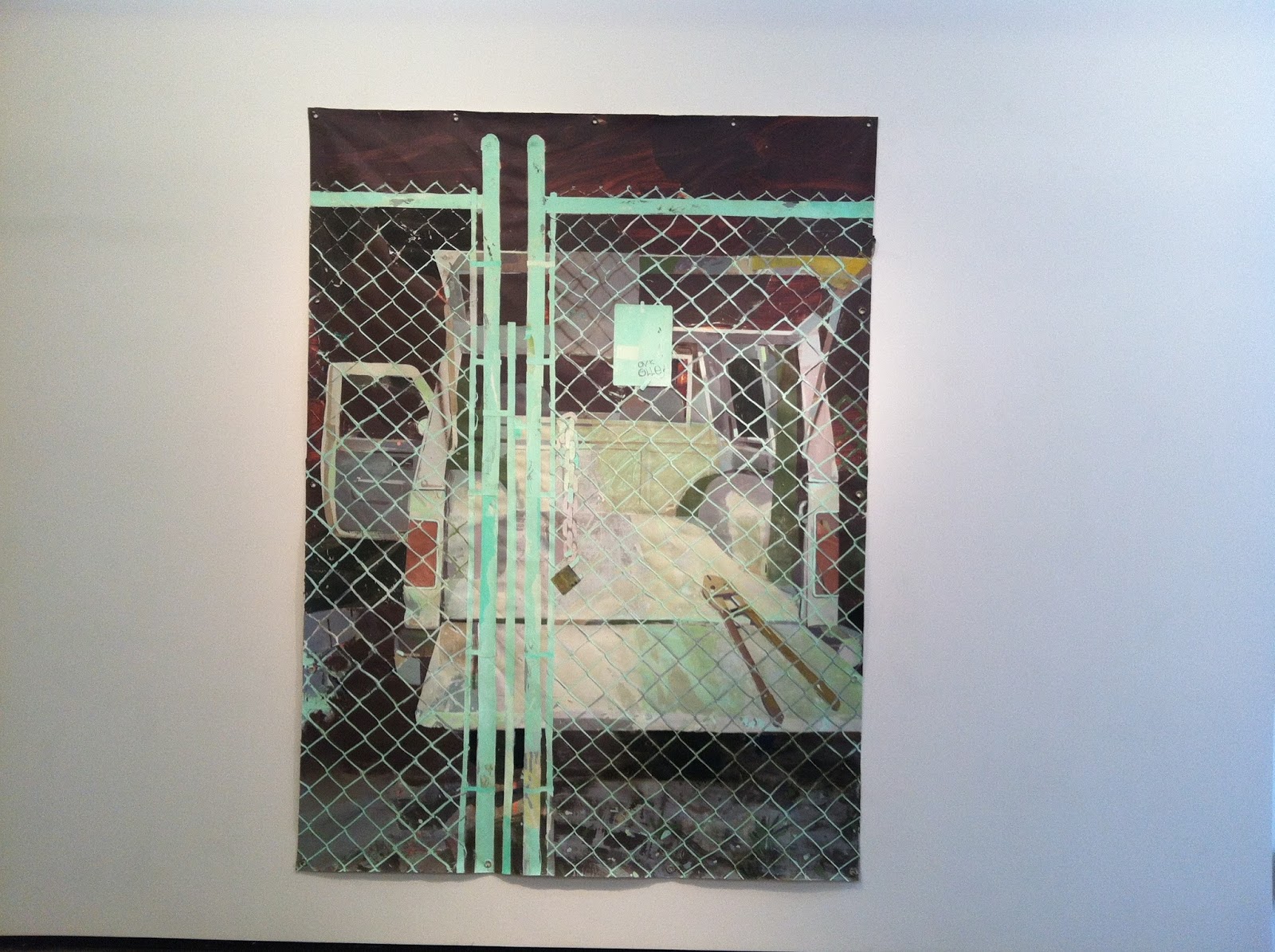
This work is collaged paper, an early work from the series. Painter Jenny Dubnau told me about this show. |
 |
| Detail of the collaged paper |
 |
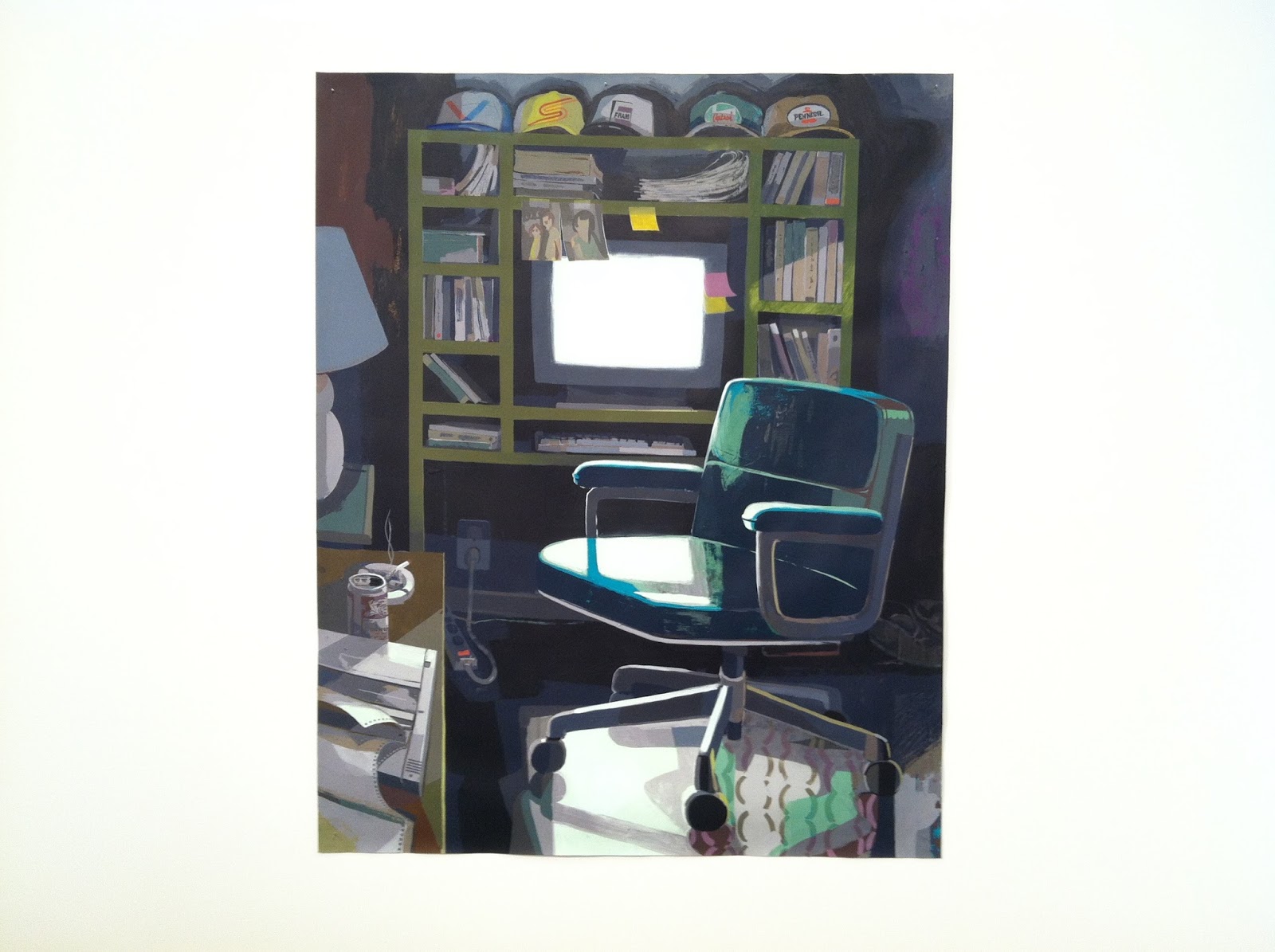
The gallery's press release states that Bollinger, a native of Independence, MO, is inspired by his father Skip's auto parts store, which was relocated in the family garage. "When the family business could not continue due to the competition with larger chains and his father moved the business into the family home, the garage took on a mythical dimension. The garage appeared to the young artist as a resevoir of forms." (Isn't that beautiful? How perfectly expressed).
"Through conjuring the daily life of the youth of his generation and searching his cultural roots in music as well as literature, Bollinger's work took on a deeply autobiographical character."
The two paintings above portray the apartments where his parents resided when they first met in the 1970s. |
 |
| Memento of the times: Rolling Stones' Hot Rocks. |
 |
| Self portrait of the artist |
 |
| Handmade audio recounting Bollinger's father Skip's stories about the first car he bought. |
 |
| Matt Bollinger drawings |
 |
| Add caption |
 |
| Videos in the back streaming drawings in a sketchbook being made, revised and added on to, complete with scratchy sounds of the pen. It's a beautiful show by a talented painter, his fourth at Zurcher. |
 |
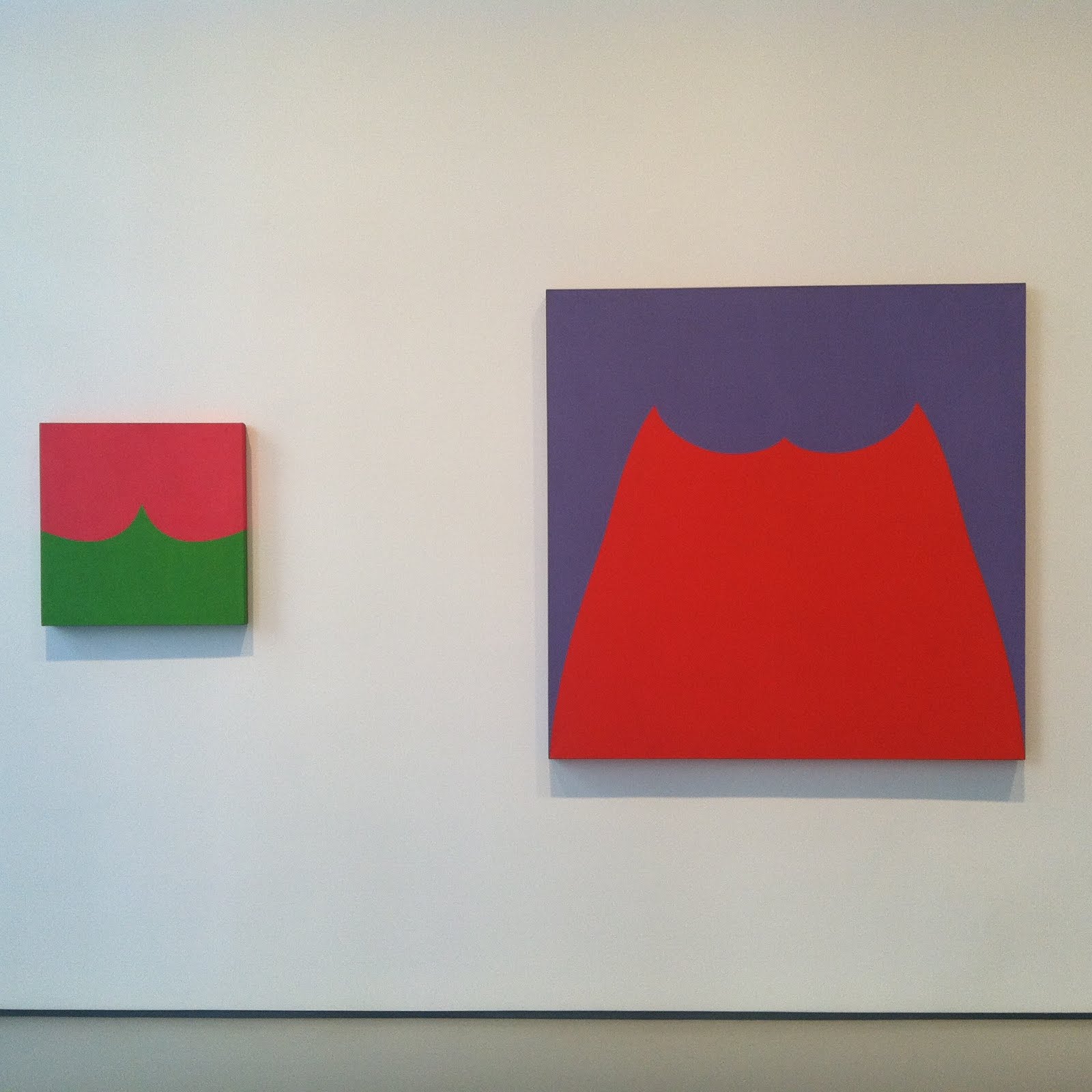
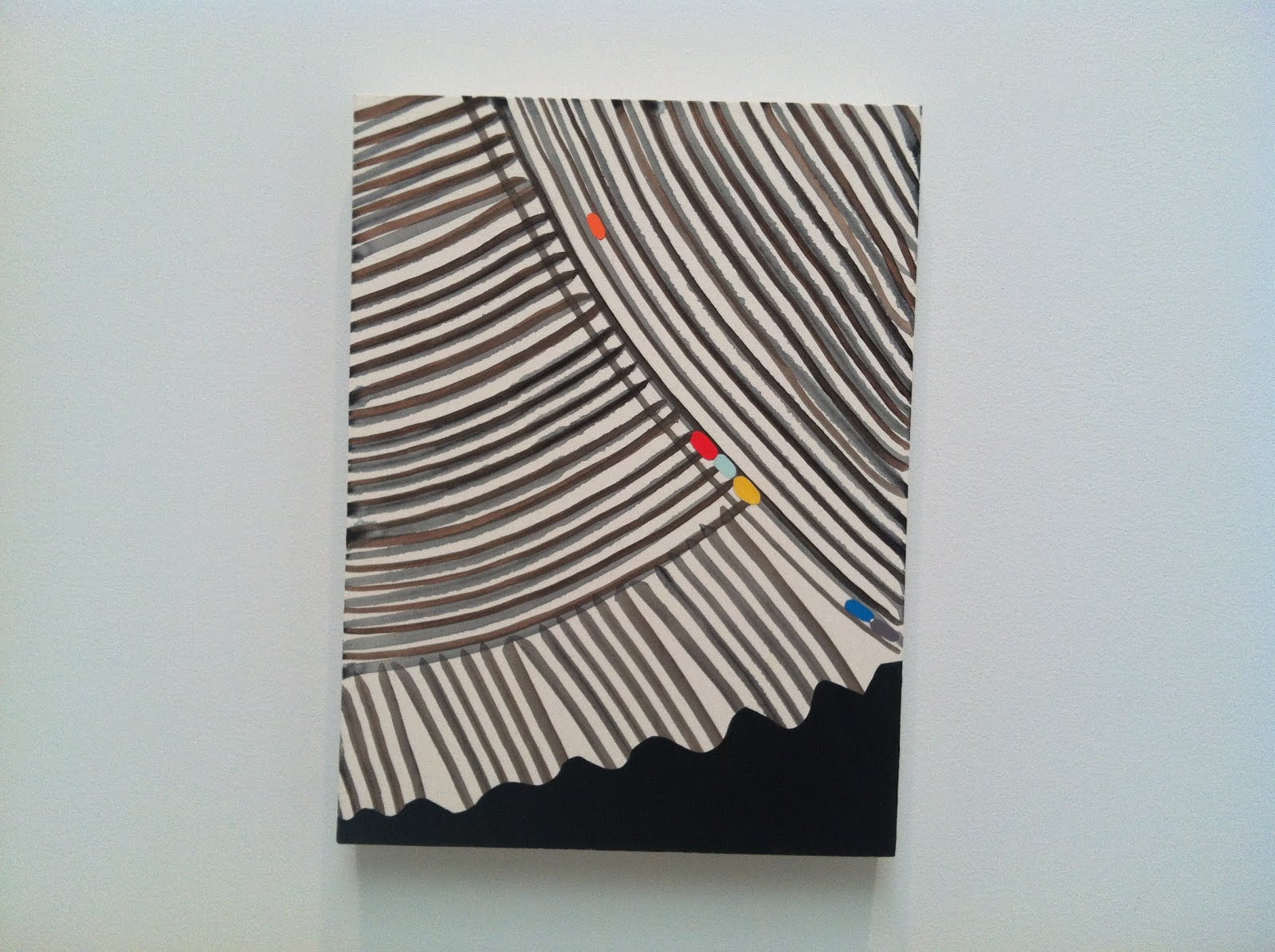
At 11R, a three-person exhibition with Ree Morton, Rebecca Morris, and Josh Blackwell.
Gallery Link |
 |
| These two-sided plastic bags are lavishly stitched and embroidered by Blackwell. They are similar, but more complex than what he showed last year at Songs for Presidents. The back view of this bag is two more images down. |


 |
A third, front view only. On the website Romano Grave Blackwell speaks of his interest in fashion:
"My interests, and consequently my practice has tended to fall between, around, and outside of established disciplines. Fashion is fluid in that it speaks to many discourses: art and film history, sociology, economics, psychology, anthropology, and political science. Yet it does not sit comfortably within any of these silos. I have always been interested in fashion, but I didn’t think of it as essential to my work as an artist until I began teaching. My first teaching job was a cultural studies seminar I devised called “Fashion and Modernism.” The course evolved out of research into historic costumes designed by avant garde artists like Sonia Delaunay, Varvara Stepanova and Ernesto Thayaht as well as fashions by Paul Poiret and Elsa Schiaparelli. Drawing connections between Modernism as an historical movement and the sociological implications of fashion at the turn of the twentieth century, I found new and continuing interests in domesticity, leisure, work, and the readymade. Fashion’s interface with artists and the art world during this period was vital; color, pattern, and form were politically charged and visually agitated. These notions continue to influence and shape my own work." |
 |
| Rebecca Morton's painting (Blackwell's three works to the right). A fresh combination. |
 |
Barbara Friedman's solo exhibition Decollation at Buddy Warren Gallery.
Gallery site
Barbara Friedman's site:
Friedman's site
Above, the face-off between ruff and roof that fuels the diverse and multiple works in the show. |
 |
| After years of building an image then sweeping the paint to blur it, Friedman's new works show their construction openly and unreservedly. The scale changes invoke a Gulliver-like disorientation, while the figures and their roof-striping have a military presence. Decollation is defined as beheading! The brick wall behind is not lost on the patterning, either. |
 |
| The roof becomes a body...in one painting, the four sides become a Gumby splayed over the surface. |
 |
If the sides of a roof comprise a body, the head in this ruff might be the torso. Lots of visual pattern games in this show.
A grouping of paintings and sculptural collages in the rear of the gallery function like a sketchbook, showing Friedman's light-hearted evolution to direct figuration. |
 |
| Upstairs, After Gutai, a solo show of paintings by Daniel M. Rosenbaum. These details are from large paintings that create abstract shapesfrom the process of swiping paint (and encaustic) over canvas on the floor. The artist wears protective clothing for full-body engagement and subsequently edits the mass with areas of opposing color. |
 |
| The swipes are beautiful, creating strange and organic forms; I found the edits less convincing as spatial boundaries. |
 |
| Detail |
 |
| Rosenbaum showed two huge paintings on either side of the second floor in addition to smaller works. The smaller works made double patterns, as this one above. On Rosenbaum's website, linked here, you can observe his painting process in a video that reveals his interest in Gutai and T'ai Chi in making his work. Rosenbaum's website. |