Sunday, June 01, 2014

Ross Lewis at Front Line Contemporary


I met Ross Lewis, now exhibiting drawings with Chinese colleague Qiu Deshu at Front Line Contemporary, Shanghai, over dinner at M on the Bund with mutual friend Caitlin Reilly. What a delight to meet someone so fluent in, and passionate about, Chinese culture. Ross has studied Chinese language and painting since 1973, and is fluent in both. Here, he delivers a bilingual lecture on his work at the gallery. Link to Front Line Contemporary.

In the past few years, Ross jettisoned the brushwork and tropes of Chinese landscape (mountain, water, cloud, plant forms--what he calls the "ABCs for an internal language") in favor of rope and colorful mulberry paper as mark making techniques on rolls of Saunders paper. (Hence the name of the exhibition, Cracks and Ropes.) In the scroll-like drawings, human figures materialize as both fluid and geometric, defined by the rhythm of embodied call and response as rope intersects with color and shape. Cut edges and stencils urge movement through space in which Chinese landscape circa 1347, Long Island City, 2014, and the graphic aesthetics of the 1970s and '80s coalesce.  These works are filled with purposeful visual ideas, especially the various applications of rope impressed within the paper surface. 

To the right, Qui Deshu's rice paper work that uses the tear as one kind of line, Ross Lewis' work on left.

The computer shows the process of inking and impressing the rope on paper. Rope yields a surprisingly elegant and varied line. Anyone who has studied Chinese painting knows how challenging it is to master its rhythms and then challenge it with a method of one's own, so in Chinese painting, this is a breakthrough.

Dynamic works such as Vine, Precipice, Totem, Lieben Lied, and 3 Monkeys (2010-2012), at 9 by 5 feet, were too large to show in Front Line Contemporary's elegant and intimate space. They are included in a catalog at the gallery.

Flatline, 40 x 26 inches, 2010, reveals the transition from brush to rope.

Ross provided exhibition images and paparazzi shots. His friend Zhang, based in Brooklyn and China, was in town for the event.

Two artists : Ross Lewis and Qui Deshu.

Ross reminded me how rice paper layers and deepens the tone of the mark. Now working with the material, I recognize the challenges  both in understanding Chinese landscape inside-out, and finding a way to mark that is both sensible and resonant. Painter Shitao (Wikipedia) wrote eloquently about the holistic brushstroke, with capacity to hold form and function together in painting. This is not just romance: a brush mark with intention contains form, which requires extreme focus.

Patricia Lambert of Front Line Contemporary with the two artists featured at the gallery.


In addition to his studio work, Ross Lewis holds public commission to his credit (in New York, these include Belvedere Castle, NY Hall of Science, Queens, and PS.1 89) and workshops / demonstrations at the Met and elsewhere.  For more information visit http://www.rosslewisartist.com.

Sunday, May 25, 2014

K11 Concepts Limited; K11Art Mall

Lock Your Dream

Not an art piece per se, but part of the K11 Art Mall experience. K11 opened in January 2013 and has gained momentum as a site where contemplation and commerce intersect. It is conceived of by the scion of an art collecting family, Adrian Cheng. He said in an online interview, which I now cannot find, that "Shanghai K11 Art Mall is our brand's first art mall in the Mainland which merges art appreciation, experience of humanity and environmental consciousness, as well as shopping. Located in the bustling area of Shanghai, it boasts international brands, many of which have chosen the art mall as the location of their first flagship or concept store, which proves the success of the business model of K11. In the next few years, the K11 brand and its multi-cultural lifestyle zone will expand to 10 locations in the Mainland, namely Shenyang, Wuhan, Beijing, Guangzhou, Tianjin, Guiyang, Guanggu, Qingdao, Haikou and Ningbo, spanning more than 160,000 sq m, with a nice blend of commerce and art integrated spaces." As in all things Chinese, K11 balances multiple perspectives.
In this video (context below) Marilyn smokes and at one point Warhol appears top left. The colors change and smoke emits. 

Context for the Marilyn video. The art is often placed near signage and illuminated lamps. On the 6th floor there is a rooftop garden; there is art all over the mall and maps directing visitors. It changes the context of seeing a little--one looks at a dress, a video, as constructed objects, no sacrosanct white cube.

I visited K11 to see Monet's first exhibit in Mainland China, located on the bottom floor of the mall. The works were borrowed from the Marmatton Monet in Paris. Having visited the Marmatton in 2006 in a life changing experience of the late paintings, I wanted to see them again.

The first room of the Monet was tepid, and I braced for the second room as a loss of the 100 RMB admission (16.20, by today's conversion amount). But the second room was stellar. The boat painting, four flower paintings with great color shifts and compositions, including an unlikely naples yellow, lavenders and fruity greens, plus the late bridge paintings were there.  On a Tuesday morning, crowds were minimal. It was fantastic.

On the second floor someone touches the wall painting to see if it is real.

There is a store that sells art works.


A large work by Jean-Michel Othoniel who enjoyed a Brooklyn Museum retrospective in 2012 (August-December),  is in an office lobby that connects to K11.


A video work by emerging Korean artist Lee Jelim, Cheer-Ajumma (housewife), whose figures don red gloves for quotidian chores that celebrate their powerful role within the family.  (from panel text)

Damien Hirst's panel

and work

Part of what I love about travel is the chance to see works I might not otherwise know or see.

K11 entrance

Speaking with a K11 assistant some days later, I learn there is urban farming as well.

And that a miniature Giverny was built for the Monet show.


It was a gorgeous day and the Monets were lovely. How I wish I could have photographed them. There was a catalog, but the reproductions were not as beautiful as the paintings. There is something about those late paintings where he reaches toward abstraction, and touches it.


Monday, May 19, 2014

Notes on a Landscape: Shanghai Museum of Art

Love this big scale and episodic format.


Free and easy brushwork. This feels so germane in Asia--much more so than in New York. It captivates.


Beautiful structure in the landscape.


Black and dilute ink, interwoven together.


So light and delicate--look at both sides of each tree

Almost kitsch in its simplicity. Funny, too.


The Four Gentlemen and more...


Kou le stroke with chrysanthemum leaf application


On these chrysanthemums note the variation in ink: black and dry,  dilute


Orchid--almost wipes out on the blossom but the leaves are so free it is balanced

Plum--great control


The beautiful big rock with 2 birds


Hanren

Add caption


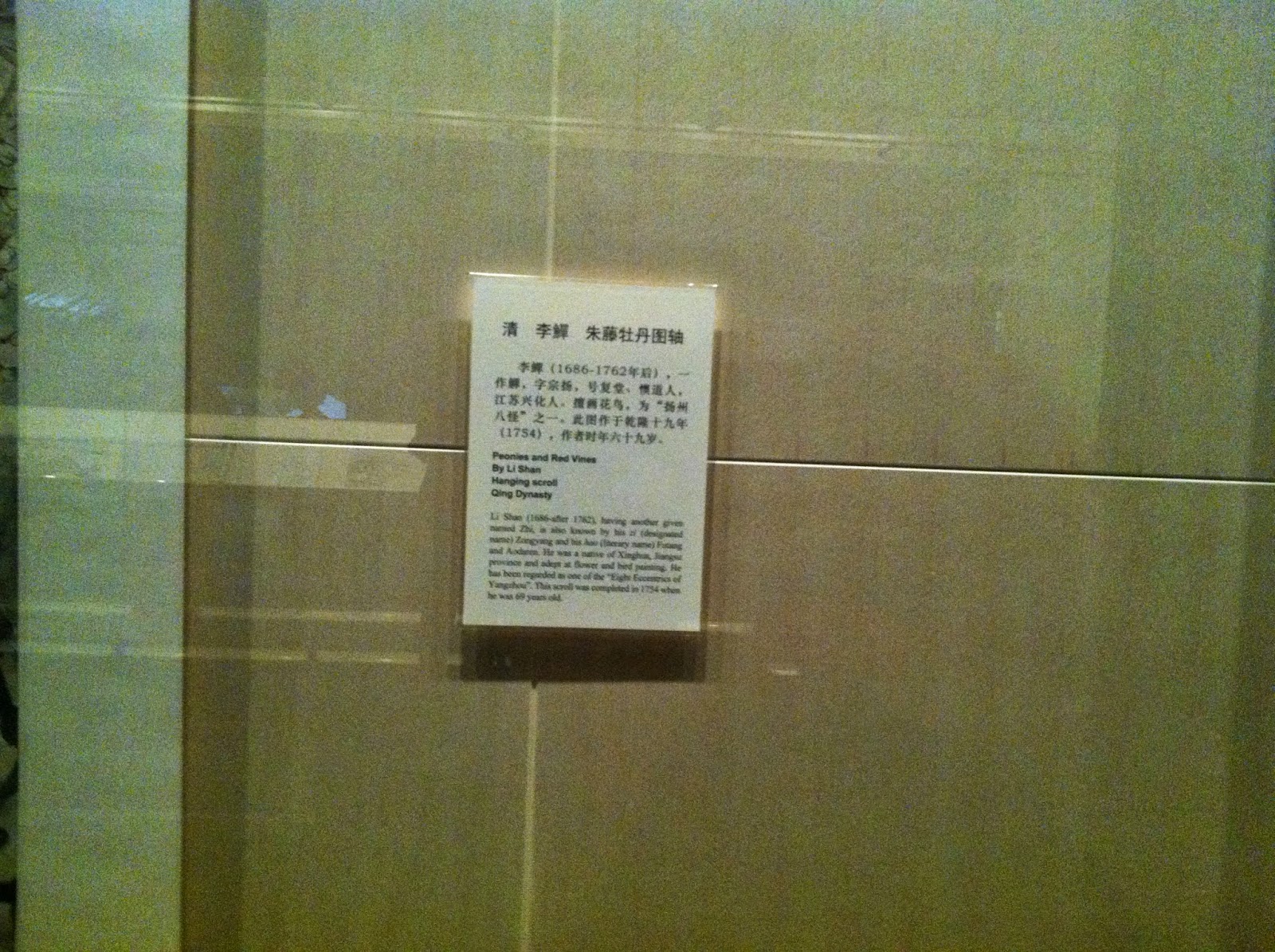
One of the Eight  Eccentrics of Shanghai--these painters are the most interesting


Color to ink

Light to dark


Bamboo


Plum - takes a lot of work to pull this off


Sweet nights cape, sky stained from back


Stylized weirdness and a lovely limpid green tint throughout

At first, passed it up

But then this got me. Reminds me of Morris Graves.